
Blue Tempo/Control: Deckbuilding Guide
By: Chestheir
Hello, Chestheir here!
In Timeless, games are often decided as early as the deck-building stage. If your goal is to spike the format, then each card you put in your 75 (or 95) should be there for a reason. Let’s do some early theory-crafting and deck building with the release of Secrets of Strixhaven.
I. Card Selection & Draw
This is why people get drawn into blue decks. The following "cantrip" suite is commonly accepted as optimal. These cards smooth the gameplay of the deck and should rarely be trimmed. Brainstorm and Ponder widen the range of keepable hands while also keeping the deck’s overall land count lower than most decks.
- 4x Brainstorm: Used to filter your hand and look three cards deep.
-
- Tip: Avoid casting during the opponent’s end step without a way to shuffle your deck, as you will likely just draw back into the cards you put on top.
- 4x Ponder: Gives ~4 fresh looks for what you need in any situation.
-
- Tip: Best used when you know what you are looking for. It effectively "expands" your hand by letting you know what is coming in future turns.
- 3x Treasure Cruise: Draw 3 Cards for U. Effectively "Ancestral Recall at home".
- Tip: It being a Delve spell makes it difficult to have online early, but seeing it at least once per game often results in a win. Which is why most existing lists will have 3 copies of this card even if their deck doesn’t build around the Delve mechanic. This number might change due to Force of Will being in the format now.
- Tip: It being a Delve spell makes it difficult to have online early, but seeing it at least once per game often results in a win. Which is why most existing lists will have 3 copies of this card even if their deck doesn’t build around the Delve mechanic. This number might change due to Force of Will being in the format now.
II. Threat Hierarchy
Magic: The Gathering in 2026 requires your creatures to be able to take over the game to be worth playing. Vanilla beatsticks like Death’s Shadow or Tarmogoyf aren't going to be enough most of the time in this format unless you wrap your entire plan around them. Here’s an early take of my personal ranking for the best threats in tempo shells:
| Rank | Card | Reasoning | Requirements |
| 1 | Hydroponics Architect | Low-commitment; draws a card each turn; trades evenly on tempo if removed. | Requires the deck to run at least 9 blue fetches. |
| 2 | Tamiyo, Inquisitive Student | Built-in protection via draw synergy (Brainstorm). The Planeswalker side is hard to remove, the -3 ability swings games, and the -7 ability ends games. | Requires the deck to run Brainstorm. |
| 3 | Ragavan, Nimble Pilferer | Rated higher now that the format has Daze. This card, being able to further develop your mana, lets you care less about using and getting dazed. Not to mention giving you a free card once in a while. | Requires a red splash. The non-evasive body means you’d have to keep the board clear for this to be effective. |
| 4 | Psychic Frog | Draws a card, has evasion, clocks fast, and ignores damage-based removal, but the 2-mana cost can be a tempo liability. This can also stop other ragavans from attacking, as it can threaten to eat them in combat, letting you get the first hit in. Can single-handedly turn the tide in desperate situations (All in on the Frog). | Requires a black splash. Costs 2 mana. |
| 5 | Deathrite Shaman | The mana advantage matters in a Daze format. The utility of also being Graveyard hate/Lifegain and being a form of reach is also relevant. | Requires a black/green splash. Graveyard hate is only enabled if you have access to G. |
| 6 | Dragon’s Rage Channeler | You’re playing this because you think closing the game faster is better than drawing more cards. The card selection does translate to card advantage over time. | Requires Delirium, which means you’re probably taking 4 slots for Mishra’s Bauble. |
| 7 | Dreadhorde Arcanist | Works similarly to Psychic Frog, although a lot weaker. I’d run Tamiyo or Cori Steel-Cutter first before considering running Arcanist. | Requires a red splash. Costs 2 mana, no evasion, vulnerable to Graveyard hate. |
| 8 | Delver of Secrets | You’re playing this because you can’t let go of nostalgia. Let it go, old man.Mostly played because the flipped delver is a free Lightning Bolt per turn. | Requires ~28 instants/sorceries to make the blind flip a coin toss. |
| 9 | Kaito, Bane of Nightmares | A good way to break blue mirrors is because of how hard it is to remove. You’re going to need more reasons to cut Lurrus, though. | Requires you to cut Lurrus of the Dream-Den and build the deck around enabling Ninjutsu. |
| 10 | Barrowgoyf, Wary Zone Guard, Abhorrent Oculus | Playing 3 drops in a format with Daze and Strip Mine is ambitious. Not recommended, as these things often trade down in mana either by getting removed or countered. | Requires you to cut Lurrus. |
| Rank | Card | Reasoning | Requirements |
| 1 | Hydroponics Architect | Low-commitment; draws a card each turn; trades evenly on tempo if removed. | Requires the deck to run at least 9 blue fetches. |
| 2 | Tamiyo | Built-in protection via draw synergy (Brainstorm). The Planeswalker side is hard to remove, the -3 ability swings games, and the -7 ability ends games. | Requires the deck to run Brainstorm. |
| 3 | Ragavan | Rated higher now that the format has Daze. This card, being able to further develop your mana, lets you care less about using and getting dazed. Not to mention giving you a free card once in a while. | Requires a red splash. The non-evasive body means you’d have to keep the board clear for this to be effective. |
| 4 | Psychic Frog | Draws a card, has evasion, clocks fast, and ignores damage-based removal, but the 2-mana cost can be a tempo liability. This can also stop other ragavans from attacking, as it can threaten to eat them in combat, letting you get the first hit in. Can single-handedly turn the tide in desperate situations (All in on the Frog). | Requires a black splash. Costs 2 mana. |
| 5 | Deathrite Shaman | The mana advantage matters in a Daze format. The utility of also being Graveyard hate/Lifegain and being a form of reach is also relevant. | Requires a black/green splash. Graveyard hate is only enabled if you have access to G. |
| 6 | Dragon’s Rage Channeler | You’re playing this because you think closing the game faster is better than drawing more cards. The card selection does translate to card advantage over time. | Requires Delirium, which means you’re probably taking 4 slots for Mishra’s Bauble. |
| 7 | Dreadhorde Arcanist | Works similarly to Psychic Frog, although a lot weaker. I’d run Tamiyo or Cori Steel-Cutter first before considering running Arcanist. | Requires a red splash. Costs 2 mana, no evasion, vulnerable to Graveyard hate. |
| 8 | Delver of Secrets | You’re playing this because you can’t let go of nostalgia. Let it go, old man.
Mostly played because the flipped delver is a free Lightning Bolt per turn. |
Requires ~28 instants/sorceries to make the blind flip a coin toss. |
| 9 | Kaito, Bane of Nightmares | A good way to break blue mirrors is because of how hard it is to remove. You’re going to need more reasons to cut Lurrus, though. | Requires you to cut Lurrus and build the deck around enabling Ninjutsu. |
| 10 | Barrowgoyf, Wary Zone Guard, Abhorrent Oculus | Playing 3 drops in a format with Daze and Strip Mine is ambitious. Not recommended, as these things often trade down in mana either by getting removed or countered. | Requires you to cut Lurrus. |
III. Interaction & Removal Orcish Bowmasters
(Recommended: 3-4 slots in the 75)
- I cannot stress enough that this card is just that good (except by giving its own section here). This is the best card to win Blue Control/Tempo Mirrors and is also the card that beats The One Ring. Not to mention, it is also the best answer to itself.
- It’s not a hard requirement, but do be warned that blue decks without these will be noticeably harder to pilot. It’ll also be difficult to win the mirror without these as they’re free to maximize their use of Brainstorm/Ponder/Treasure Cruise.
Removal (Recommended: 8–10+ slots in the 75)
The Removal Color Tier List: White > Black > Red > Blue > Green
- White has the most flexible removal spells available. Meaning they can afford to play them without having it be dead in some match-ups. Swords to Plowshares can remove any creature that can be targeted. Prismatic Ending can remove any nonland permanent that’s within 3 MV (more if you have access to 4-5 colors). Fragment Reality is the most flexible, as you can safely run this vs combo decks, with it having a relevant target all the time. This makes this color splash resilient to sideboard jukes.
- Black has Fatal Push, Bloodchief’s Thirst, and Sheoldred’s Edict. All are often good enough in the format for removing creatures, but each does have a limitation. The gap between the best removal color splash and the second best is huge, as this color doesn’t have catch-all answers like Prismatic Ending and Fragment Reality.
- Red has its iconic spell, Lightning Bolt. It’s a flexible removal spell, as it can be used as player removal when it has no targets. This color has some decent options for dealing with anti-blue hate, such as Abrade/Suplex, which can deal with Hexing Squelcher, Vexing Bauble, or Chalice of the Void.
Sweepers (Recommended: 2–4 slots in the 75)
Sweepers are recommended due to the presence of Energy. Although sweepers will not be enough alone, as they can rebuild a board with an Amped Raptor.
- Fire Magic: The best sweeper against Energy due to its instant and modal nature. It cleanly answers Orcish Bowmasters for R. The downside is you’d have to splash for Red, which isn’t a great splash color, especially in terms of interaction.
- Toxic Deluge: The cheapest and most flexible sweeper Black has access to. It also requires only a B and 2 generic mana to cast. Generally, less color-intensive spells are preferred since most tempo decks are Mono-Blue. You don’t want a strip mine preventing you from casting your sweepers.
- Wrath of the Skies: The best one if it were cheaper. It also takes care of Goblin Bombardment or can be used to clear Chrome Mox/Chalice of the Void. In the energy match-up, this would generally cost 2WW, which is unfortunately too slow. You can also run this over the ones above if affinity becomes too popular.
- Pest Control: Similar to Wrath of the Skies, but only clears 1 drops and tokens. Against Energy, you also would want to hit a lot of their 2 drops. It also destroys your own Tamiyo planeswalker. I don’t recommend running this, save your Mythic wildcards.
Permission (Recommended: 4–8 slots in the 75)
- Force of Will: The best free counterspell in MTG. Counters anything for 0 mana at the expense of another blue card, no questions asked. The card disadvantage is easily mitigated by the deck's high draw power. Tip: You want your overall blue card (including itself) count to be ~20 for this to be consistently available Turn 1.
- Daze: The reason why legacy has all their “Ragavans” banned. This card is simultaneously the best and worst counterspell here. Hindering your own mana development will be awkward, especially if you’re on the draw. People will also play around this card or learn to play around it. Best used when your deck is running 4 Strip Mine.
- Force of Negation: This is still worth looking at in the main deck if your deck poorly supports Daze. This will mostly be a sideboard card now that we have Force of Will in the format.
- Subtlety: Excellent in creature-heavy metas. Synergizes with Strip Mine to keep opponents off the mana needed to recast their spells.
- Stern Scolding: The premier answer for the mirror match and energy decks (answers Orcish Bowmasters cleanly).
- Spell Pierce: The best non-creature countermagic alongside Force of Negation.
- Mana Drain: Generally too slow for tempo; better suited for "Draw-Go" control shells. Notably worse due to the presence of Strip Mine.
- Thoughtseize: Great against Combo or Control. Always an inclusion in other eternal formats, but unfortunately, the life and tempo loss matter too much in fair matchups. Fair decks are redundant enough that casting a Thoughtseize against them backfires. Good catch-all spell if you’re limited to playing only blue and black.
- Commandeer: This used to be the best card against Necro Reanimator. This card steals their payoff, which usually just ends games against them. Useful against Show and Tell to steal Stock Up or win a stack battle. Also has niche uses against greedy control piles running Planeswalkers like Oko, Teferi, Jace, or Narset. When you have Force of Will and Force of Negation as options, you should just choose that unless you have a good reason to run Commandeers. Tip: You want your overall blue card (including itself) count to be ~30 for this to be consistently available Turn 1. It’s probably not worth running if your deck can’t support the blue count, as it’ll be too inconsistent anyway.
IV. Metagame Adaptations
1. Removal/Control Heavy Meta
If most opponents are playing 8+ removal spells, consider:
- Transitioning to a creature-less control build. This lets you blank most of their cards while developing enough advantage through non-creature spells. The concept is to essentially have more effective cards than your opponent, letting you pull ahead and have inevitability.
An example is utilizing the Chorus Package (Hymn to the Ages + Ribald Shanty) and playing Cori-Steel Cutter as your main closer (Jeskai Chorus).
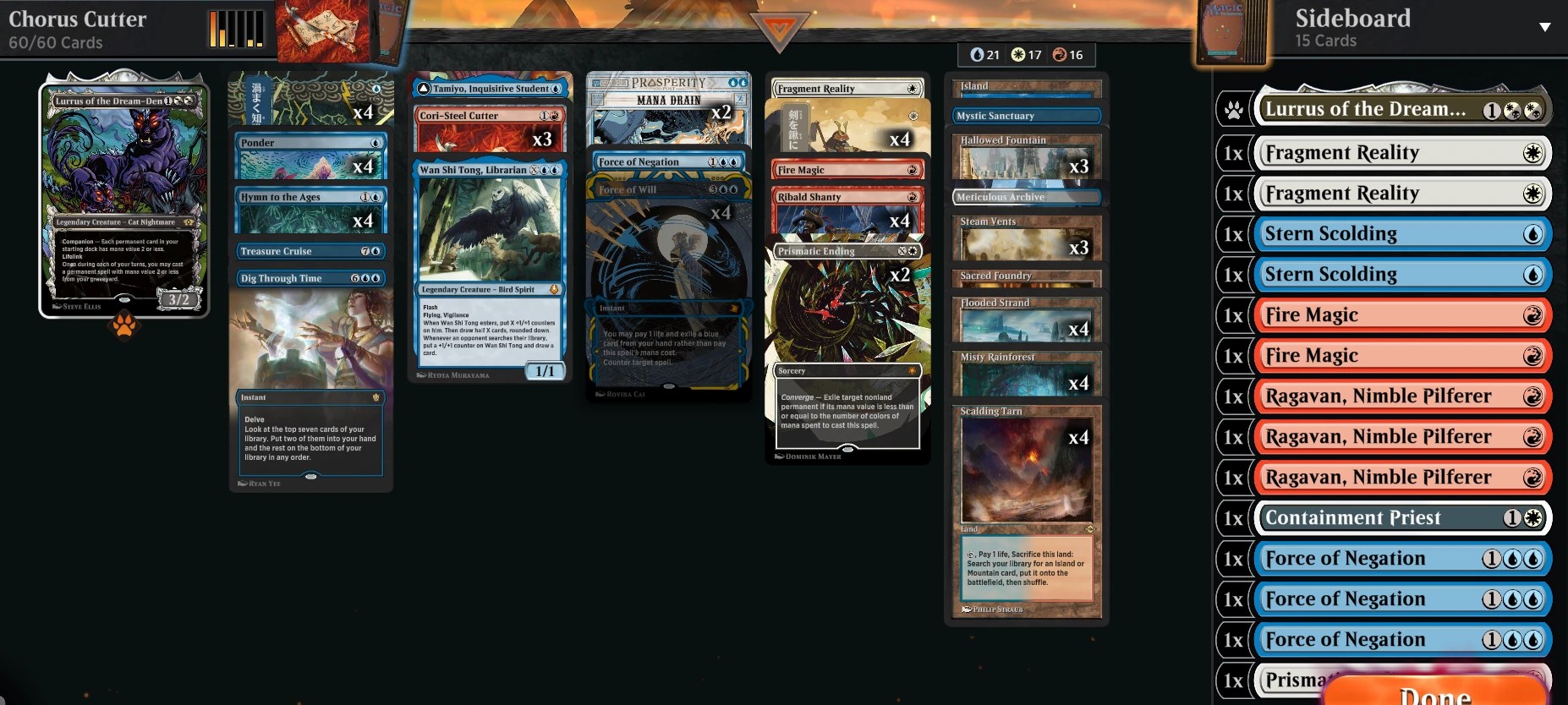
Playing minimal threats as possible that are difficult to answer or provide card advantage on the same turn they enter.
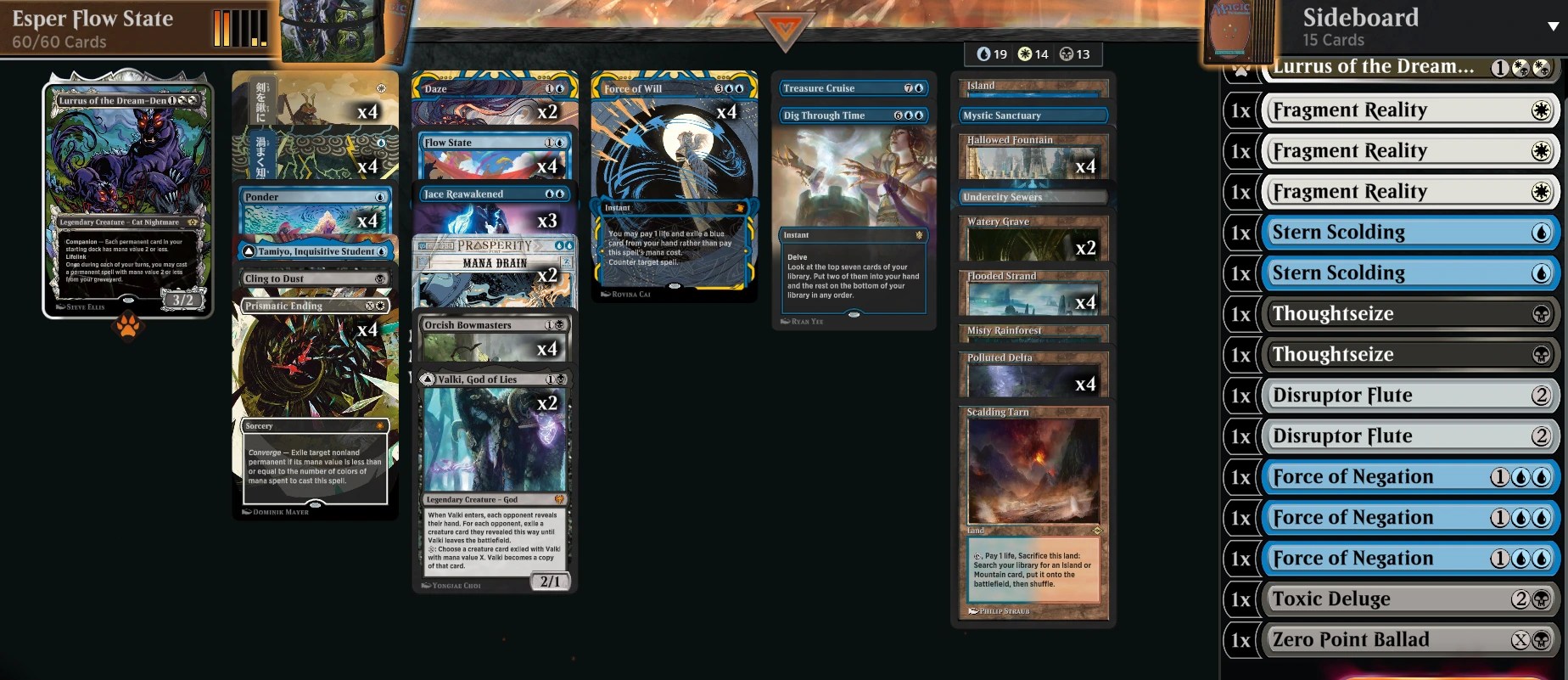
- Adding cards that generate more cards when played, like Expressive Iteration, Flow State, or Stock Up to bridge the gap going to Treasure Cruise. Here’s an updated version of Jace/Valki Control, which used to be a meta deck before Modern Horizons 3.
Utilizing Up the Beanstalk as a card advantage engine, alongside other non-creature “threats”, or creatures that provide value upon entry.
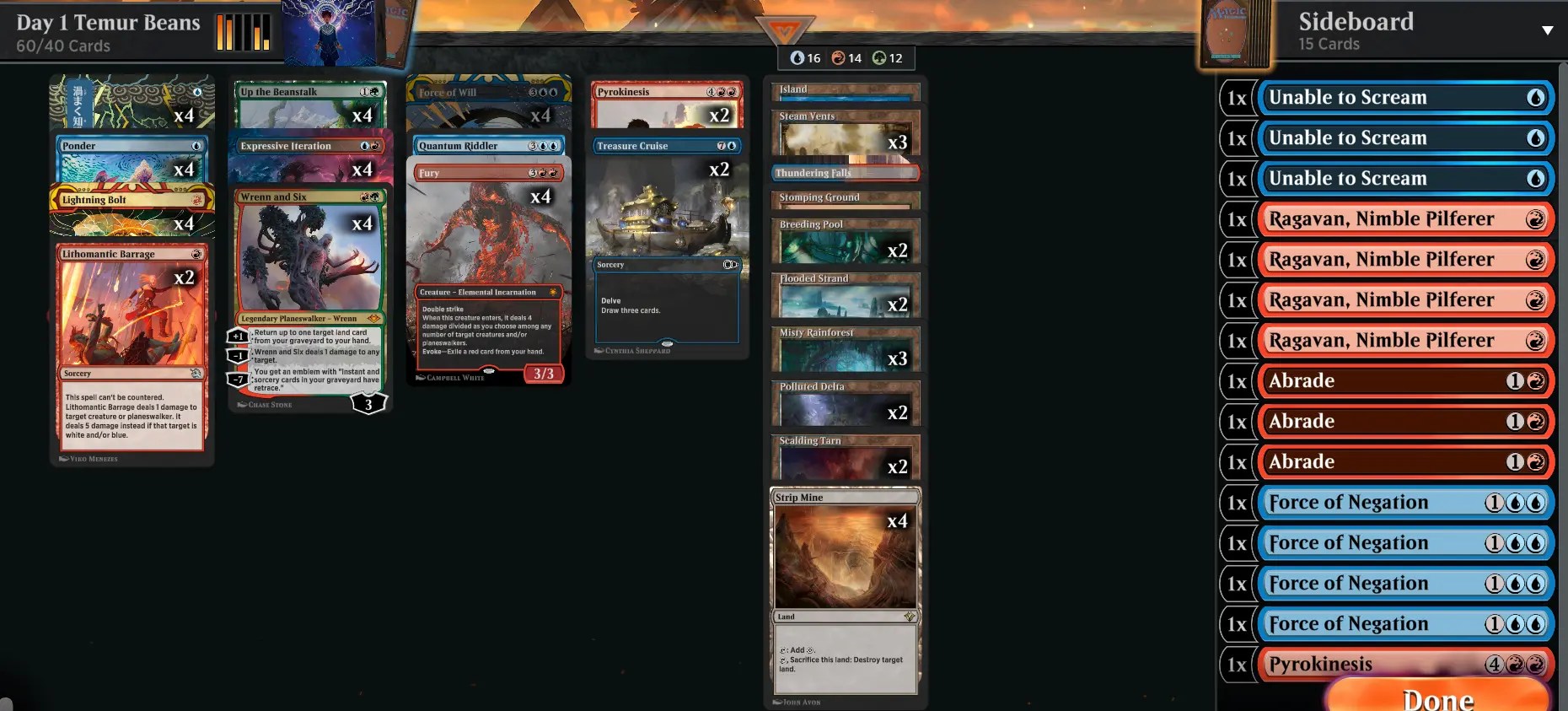
- Playing more ETB (Enter the Battlefield) creatures like Orcish Bowmasters, Quantum Riddler, or Wan Shi Tong to ensure value.
2. Combo/Stompy Heavy Meta
If the meta is defined by Dark Ritual, Moxen, or Ancient Tomb:
- Add insurance for when you are On The Draw (OTD), such as Subtlety or maindeck Force of Negation.
- Include interaction spells that cover a variety of permanents, such as Fragment Reality, Prismatic Ending, or Brazen Borrower.
- Run hard removal checks such as Psychic Frog or Ragavan as these decks don’t have as much removal.
- Play a deck that pressures the life total, like UR Tempo

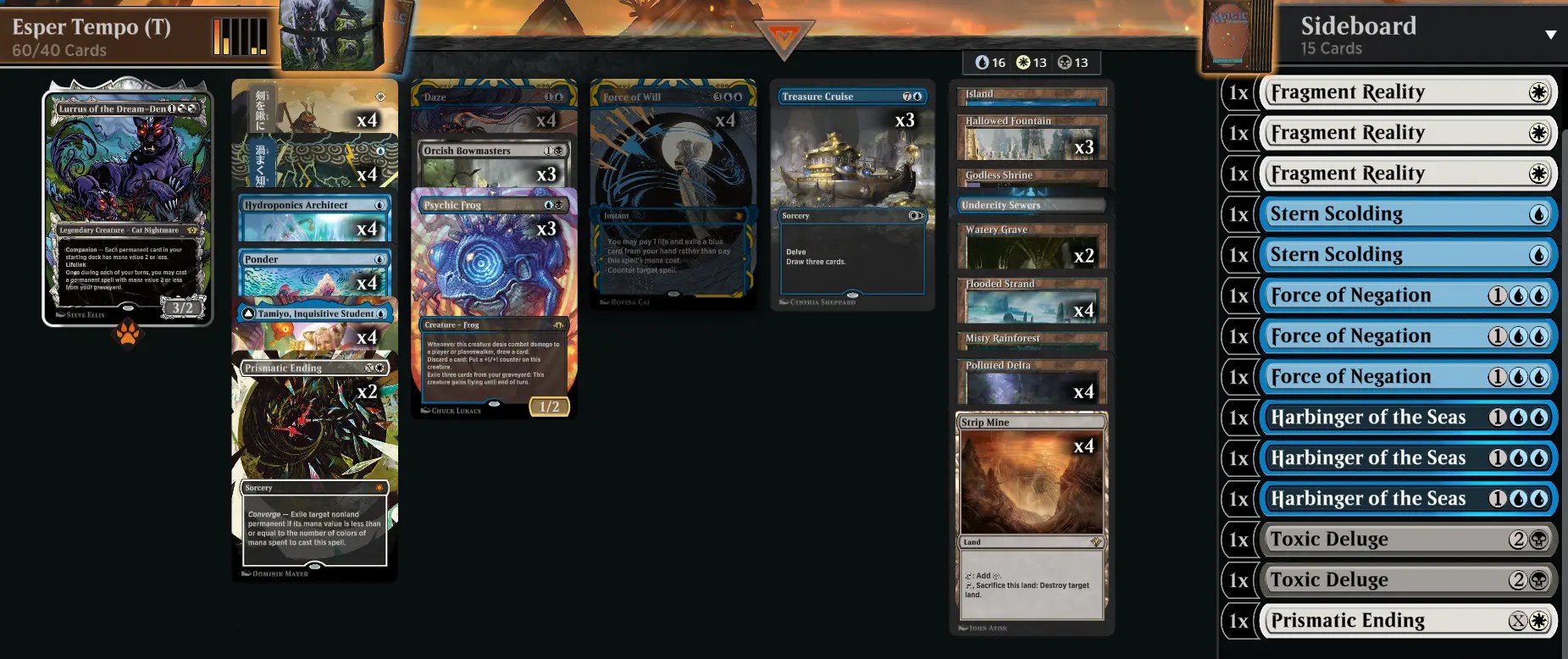
- Swords to Plowshares, Prismatic Ending, and Fragment Reality are all the most efficient and versatile answers you can play in this format. You’re rarely going to encounter some tech that you won’t be able to answer.
- Almost all versions of Tempo aren’t favored against energy but this one is the most disadvantaged because of the manabase and lack of cheap sweepers like Fire Magic. It has to resort to the unconventional strategy of locking them out with Harbinger of the Seas post-board.
V. Land Count Math (Timeless Version)
A hand is considered "keepable" if it has at least 2 Islands OR 1 Island + at least 1 Cantrip/Strip Mine/Land cycler/Mana Dork/Daze (Supporting Cards). To make the calculations simpler, we’re going to take only a couple of Fail Case Scenarios and then subtract the sum to 100%.
A hand with 0 Islands, or a hand with exactly only 1 Island without any of the Supporting Cards is considered a fail case.
The sum of fail case scenarios is calculated using hypergeometric distribution (0-land hands or 1-land hands without supporting cards).
| Build Type | Land/Cantrip Setup | Fail Case Scenarios | % Keepable Hands |
| Non-Strip Control | 20 Islands + 8 Cantrips | 0 Islands : 4.8%1 Island Only: 4.7% | ~90% |
| Blue deck w/ Strip Mine | 17 Islands + 8 Cantrips + 4 Strips | 0 Islands : 8.3%1 Island Only: 3.2% | ~89% |
| Blue deck w/ Strip Mine and Daze | 16 Islands + 8 Cantrips + 4 Strips + 4 Daze | 0 Islands : 9.9%1 Island Only : 1.6% | ~88% |
| Build Type | Land/Cantrip Setup | Fail Case Scenarios | % Keepable Hands |
| Non-Strip Control | 20 Islands + 8 Cantrips | 0 Islands : 4.8%1 Island Only: 4.7% | ~90% |
| Blue deck w/ Strip Mine | 17 Islands + 8 Cantrips + 4 Strips | 0 Islands : 8.3%1 Island Only: 3.2% | ~89% |
| Blue deck w/ Strip Mine and Daze | 16 Islands + 8 Cantrips + 4 Strips + 4 Daze | 0 Islands : 9.9%1 Island Only : 1.6% | ~88% |
To make it a lot simpler, 16 Islands + 8 Cantrips + 4 Strips + 4 Daze is the bare minimum as you want to always have keepable 7s. Adding/Removing more Islands roughly adds/subtracts ~2% chance for hitting the success rate per land. ~0.5% chance is added/subtracted per Supporting Card.
Take this with a grain of salt, as most of this was already simplified. It does not take into account hands with too many lands and avoids taking Mulligans into consideration as ideally you’d want to maximize keeping 7. I’d personally stick to a range of 16-22 Islands when trying to play around the numbers.
VI. The Essentials
If you didn’t want to read the wall of text above, then here’s what I consider every base Tempo list should have:
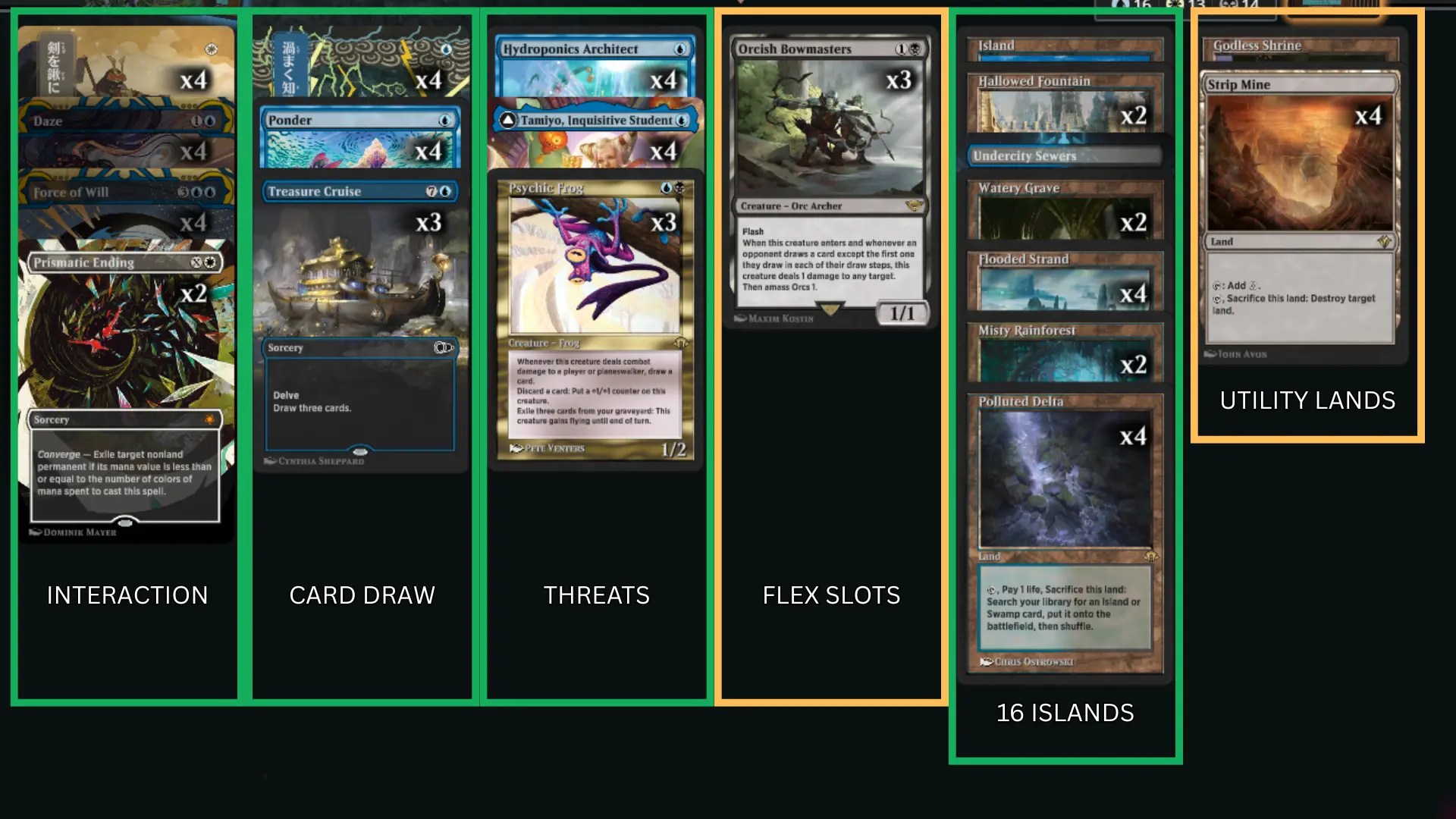
There really is not much wiggle room. Once you cut the Card Draw, you will begin to notice “wrong half” problems, and you’ll also need to readjust the manabase, too. Threats can be replaced, but in my opinion, these are already the best threats you should play in blue. The interaction suite should be replaced with whatever fits best to your personal ladder metagame.
The more important breakdown here is that the list ends up with:
- 10-16 Threats
- 11-15 Interaction spells
- 4 Ponder
- 4 Brainstorm
- 3-4 Treasure Cruise
- At least 16-17 Islands
We’ve covered everything you’ll need if you're a Best-of-One gamer, but if you play Best-of-Three, then we’re going to have to think about sideboarding plans.
VI. Building the 75
We mostly touched on building the base 60 of the deck, but it’s not supposed to be that way (unless you’re a Best-of-One gamer). When creating a deck you should already be thinking about what your deck should look like when facing specific match-ups. The specific numbers of the 15 in your sideboard should also take into account what you’re taking out for these cards.
Example: You’re up against Show and Tell. What cards are bad in this matchup?

This means, at a minimum, you should have at least 4 slots to bring in that replace the “Bad” cards for this match-up. The cards that “Could be better” are your additional slots to take out if you want extra tech or redundancy.
You’re supposed to repeat this exercise to fit your predicted metagame until you finish your 75. (As I'm writing this, I predict we’ll have to plan for Dimir Reanimator, Mardu Energy, and Other Tempo decks.)
There’s also a lot of nuance in identifying what’s “Bad” as you also have to take into account what cards actually matter. For example, Swords to Plowshares is often a liability against Show and Tell because it only becomes live after the spell resolves, at which point you’ve likely already lost. Conversely, I chose to keep Fragment Reality in the deck because many Show and Tell players bring in Carpet of Flowers to overload our mana and interaction, and it can deal with random creatures when needed. Treasure Cruise can also be trimmed for more interaction as this match-up is more focused on winning a major stack battle than playing a drawn out game where both players trade resources. Similarly, Orcish Bowmaster is decent at policing Ponders and Brainstorms, but it’s not guaranteed to be good all the time in this match-up.
Fragment Reality is a good example of a card that opens up a lot of slots in our deck since it’s a card that can be used for both combo and creature match-ups. Overlaps like these are very important as we only have 75 slots to work with.
You should also be wary of over-boarding for specific match-ups. If you’ve lost sight of what your deck is supposed to do post-board, then it’s a good sign you’ve over-boarded. In this case, when you start cutting ponders/brainstorms/threats, then you really have to take a step back and evaluate if it’s correct to do that.
Some common sideboarding heuristics:
Against an aggro/midrange/tempo deck - You’re supposed to play to the board, which means you should prefer removal spells over counter magic and discard. Determine who’s the beatdown.
Against a combo/control deck - You’re supposed to stop them from being able to take relevant game action,s which means you should be bringing in a mix of counter magic, discard, or hate pieces.
One heuristic I plan to challenge is the rule of thumb that Force of Will should be sided out in "fair" match-ups. The common wisdom suggests cutting it to avoid being 2-for-1’d; however, I want to test its limits. Given the sheer number of card advantage engines available in this format, it may actually be correct to keep it in. Conversely, the heuristic for Daze, which is to side it out on the draw, should remain a solid approach that should hold true in Timeless.
Recent Articles


